San Juan Milkweed
Asclepias sanjuanensis K.D. Heil, J.M. Porter & S.L. Welsh
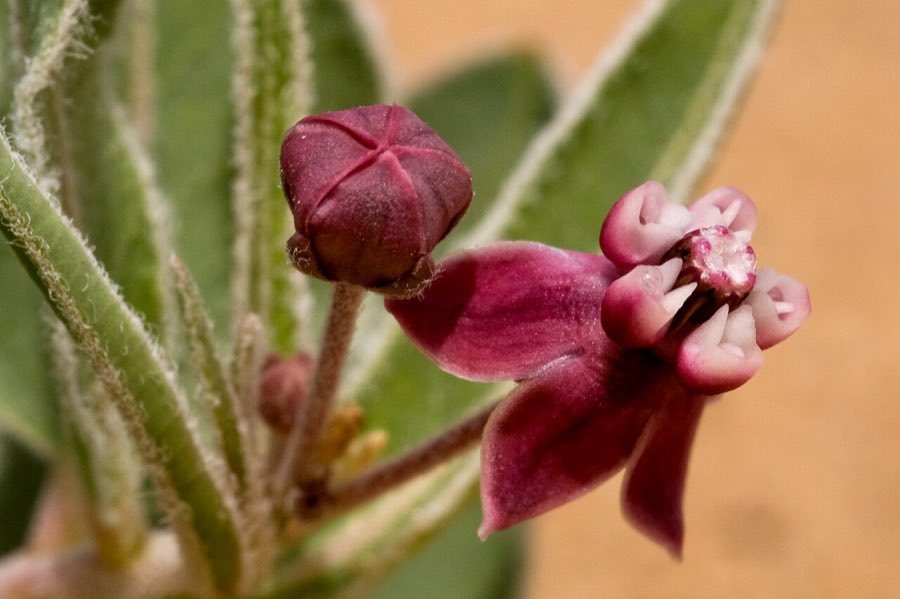
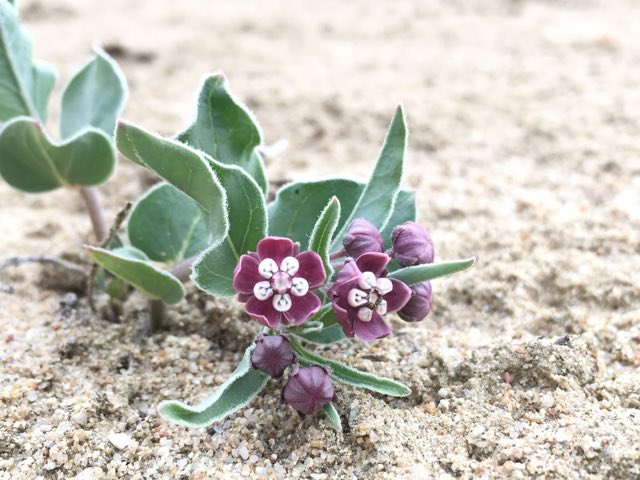
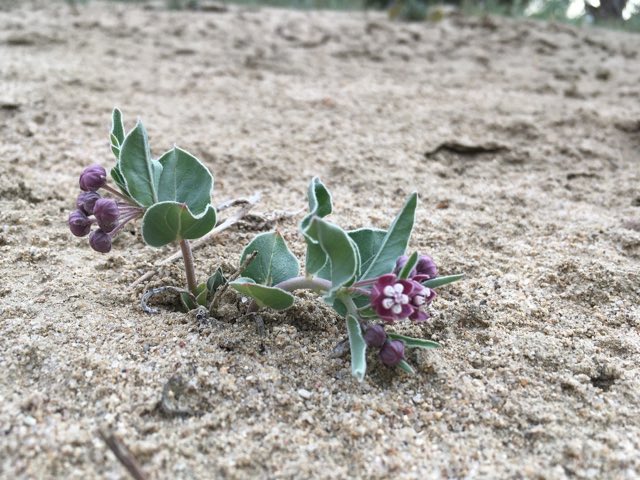
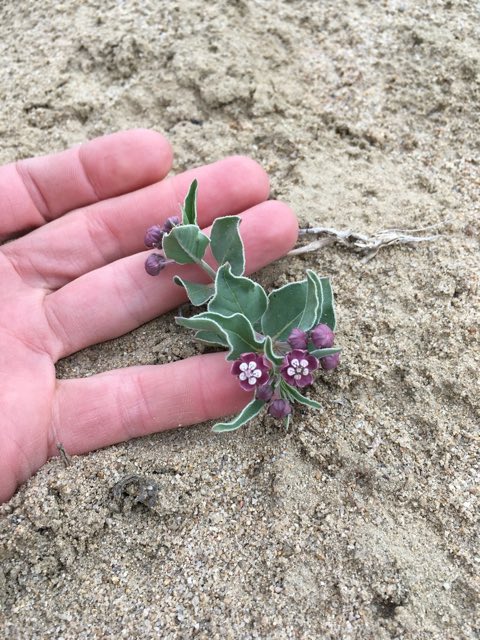
A tiny sprawling milkweed of the Four Corners sandstone country, described only in 1989, with red-violet flowers held upright on stems rarely longer than a finger. It flowers in April and May and holds one of the smallest ranges in the genus.
- Height
- 2 in–5 in
- Spread
- 6 in–1.3 ft
- Flowers
- purple, white
- Bloom
- April to May
- Light
- Full sun
- Soil moisture
- Dry
- USDA zones
- 5–8
- Leaves
- Opposite, lanceolate
- Sap
- Milky latex
- Roots
- Rhizomatous, spreads by root
- Stratification
- 30 days cold-moist
- Range
- 3 states
When it flowers
San Juan Milkweed blooms April to May, peaking in April and May.
How to identify it
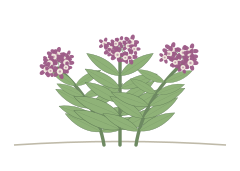
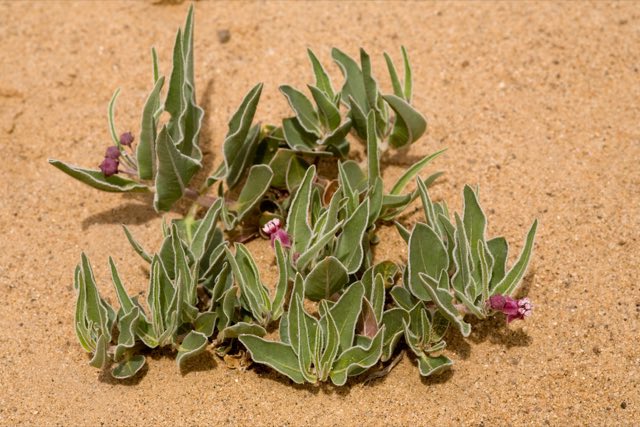
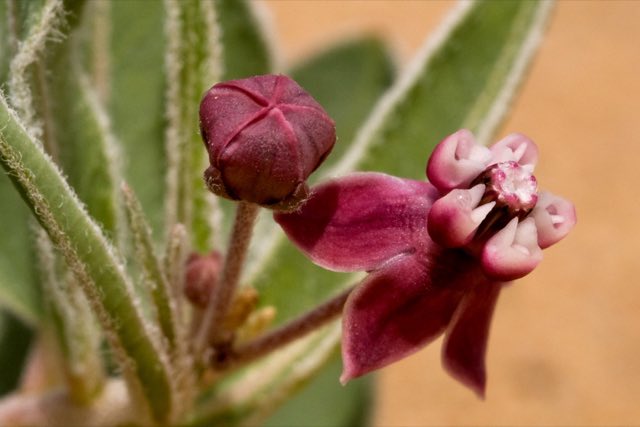
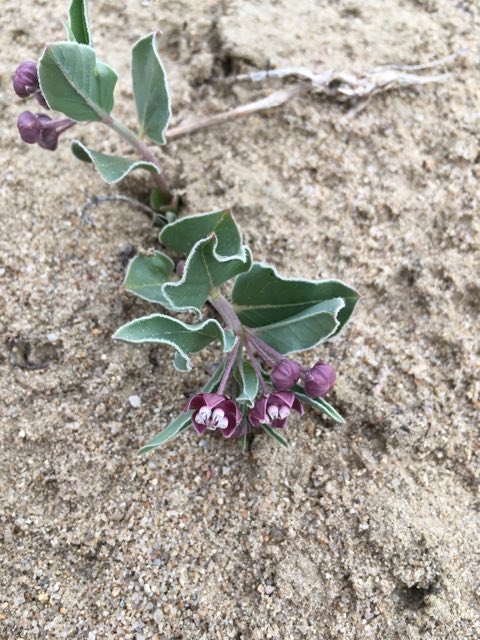
- Very small and decumbent, 4 to 13 cm, with one to eight stems from a running rootstock and dense curved hairs throughout.
- Leaves lanceolate to ovate, 2 to 5 cm, short-stalked, some opposite and some alternate on the same plant, with entire rather than crinkled margins.
- Few-flowered stalkless clusters, only 3 to 8 flowers, held erect.
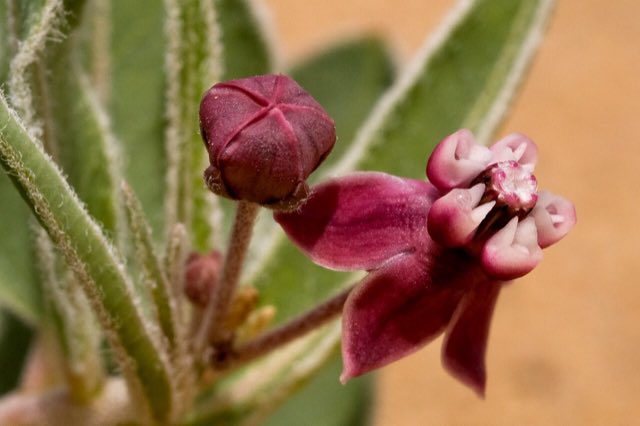
- Corolla red-violet; hoods red-violet on the back and white to orange at the base, each with a small tooth on either side of the tip.
- Pinyon-juniper woodland and desert scrub on sandstone between 1,400 and 1,800 m.
Unfamiliar words are in the glossary, and the identification key will narrow a plant down from what you can see.
The parts that identify it
Ecology and wildlife value
One of a group of four closely related Colorado Plateau dwarf milkweeds, alongside dwarf, large-seed, Eastwood’s and Ruth’s milkweed, that some botanists have treated as a single variable species. Flowering in April and May puts it among the earliest milkweeds anywhere in the West.
Monarchs are not the only thing that will find it. Expect large milkweed bugs on ripening pods, oleander aphids on the stems, red milkweed beetles at the flowers and, in late summer, milkweed tussock moths. Everything that lives on milkweed.
Growing san juan milkweed
Not in cultivation and not commercially available.
Seed needs about 30 days of cold-moist stratification. Rhizomatous, spreads by root. See how to plant milkweed seed for the full method.
Cautions
A narrow endemic, restricted to San Juan County in New Mexico, San Juan County in Utah, and Apache and Navajo counties in Arizona. Much of its range is on Navajo land. Photograph and report rather than collect. More on milkweed toxicity.
Where san juan milkweed grows
Recorded in 3 states: Arizona, New Mexico, Utah.
USDA PLANTS holds no county-level records for this species, so the map above is generalized to whole states. For what county data exists see USDA PLANTS and BONAP.
Frequently asked questions
Why is San Juan milkweed so recently described?
It was not named until 1989, by Kenneth Heil, J. Mark Porter and Stanley Welsh, because it sits inside a group of four small Colorado Plateau milkweeds that look alike and had been lumped together. Its range turned out to be wider than first thought, reaching across northeastern Arizona and just into southeastern Utah.
References and further reading
Names, ranges and conservation status here are drawn from the databases below. Where those disagree with a regional flora, trust the flora.
- Plants of the World Online 272735-2. Royal Botanic Gardens, Kew. Accepted name, authorship and global distribution.
- GBIF 3574140. Global Biodiversity Information Facility. Aggregated occurrence records.
- iNaturalist 622906. Community observations, photographs and phenology.
- Wikipedia. General-audience article on this species.
- BONAP county distribution map. Biota of North America Program. County-level range map.
- NatureServe Explorer. Conservation status ranks at global and state level.
- World Flora Online. Nomenclature and synonymy.
- Woodson, R. E. (1954). The North American species of Asclepias L.. Annals of the Missouri Botanical Garden 41(1): 1–211. The monograph the modern taxonomy of the genus still rests on. View
- Flora of North America Editorial Committee (eds.) (2026). Flora of North America North of Mexico. Oxford University Press, New York and Oxford. Accepted names, keys and descriptions for the North American flora. View
- Royal Botanic Gardens, Kew (2026). Plants of the World Online. Facilitated by the Royal Botanic Gardens, Kew. Nomenclature and global distribution, keyed to IPNI name identifiers. View
- Kartesz, J. T. (Biota of North America Program) (2026). North American Plant Atlas. BONAP, Chapel Hill, North Carolina. County-level distribution maps, the basis for the ranges generalized here. View
- USDA, NRCS (2026). The PLANTS Database. National Plant Data Team, Greensboro, North Carolina. State-level distribution, wetland status and nomenclature. View
- Agrawal, A. A. (2017). Monarchs and Milkweed: A Migrating Butterfly, a Poisonous Plant, and Their Remarkable Story of Coevolution. Princeton University Press. The standard general account of the milkweed and monarch relationship. View
Cite this page
This page is licensed CC BY 4.0. Quote it, adapt it and reuse it, including commercially, as long as you credit Milkweed USA and link back.
Milkweed USA. (2026). San Juan Milkweed (Asclepias sanjuanensis). Retrieved DATE, from https://milkweedusa.com/species/san-juan-milkweed/
"San Juan Milkweed (Asclepias sanjuanensis)." Milkweed USA, 2026, https://milkweedusa.com/species/san-juan-milkweed/. Accessed DATE.
Milkweed USA. "San Juan Milkweed (Asclepias sanjuanensis)." Last modified 2026-08-01. Accessed DATE. https://milkweedusa.com/species/san-juan-milkweed/.
@misc{milkweedusa_speciessanjuanmilkweed,
  title  = {San Juan Milkweed (Asclepias sanjuanensis)},
  author = {{Milkweed USA}},
  year   = {2026},
  url    = {https://milkweedusa.com/species/san-juan-milkweed/},
  note   = {Accessed DATE}
}