Arizona Milkweed
Asclepias angustifolia Schweigg.
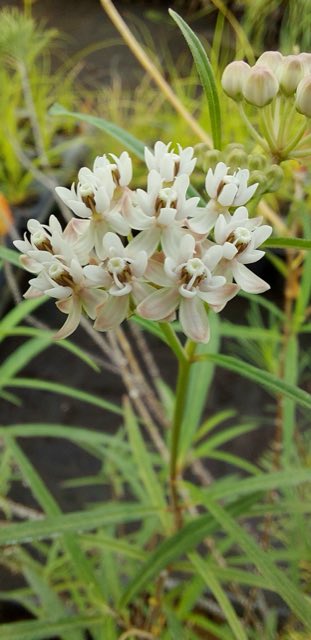
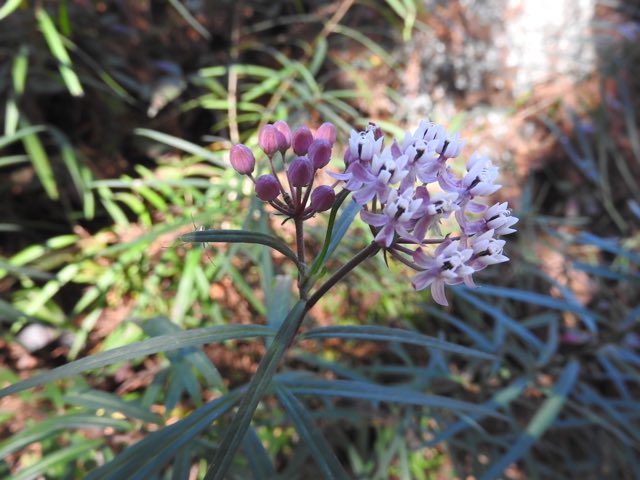
A slender riparian milkweed of the Arizona sky islands, carrying white flowers in small side umbels along the upper stem. It grows where there is water in a landscape that mostly has none, which is why it is confined to canyon bottoms, cienega edges and shaded streamsides.
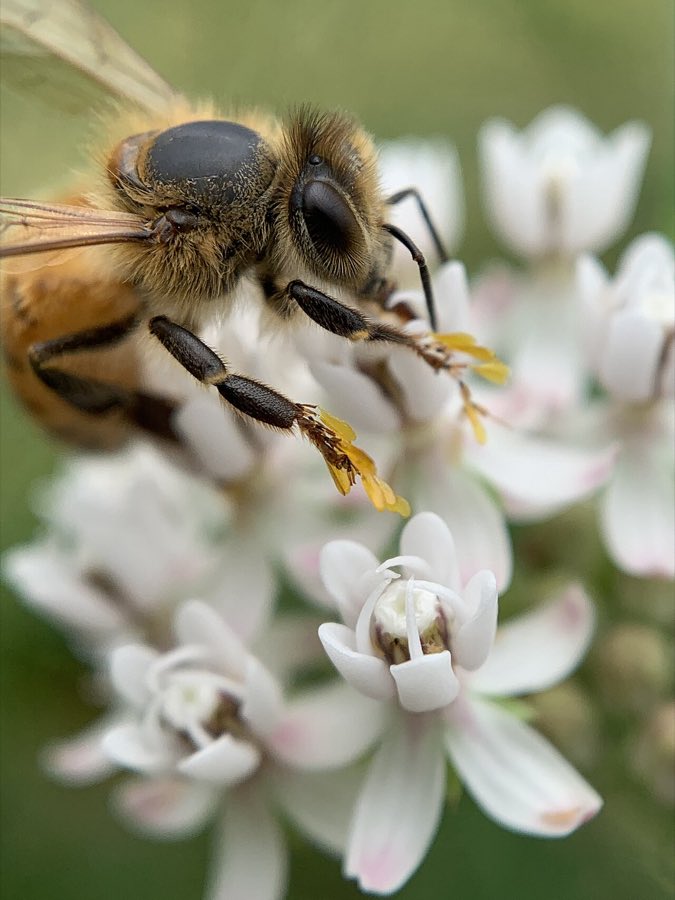
- Height
- 8 in–2.3 ft
- Spread
- 1 ft–1.7 ft
- Flowers
- white, pink
- Bloom
- May to September
- Light
- Full sun, Part shade
- Soil moisture
- Average, Wet
- USDA zones
- 7–10
- Leaves
- Opposite, lanceolate
- Sap
- Milky latex
- Roots
- Deep taproot, resents transplanting
- Stratification
- 30 days cold-moist
- Range
- 1 state
When it flowers
Arizona Milkweed blooms May to September, peaking in July and August.
How to identify it
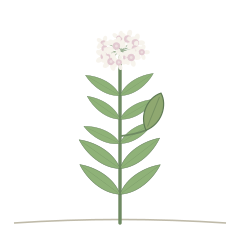
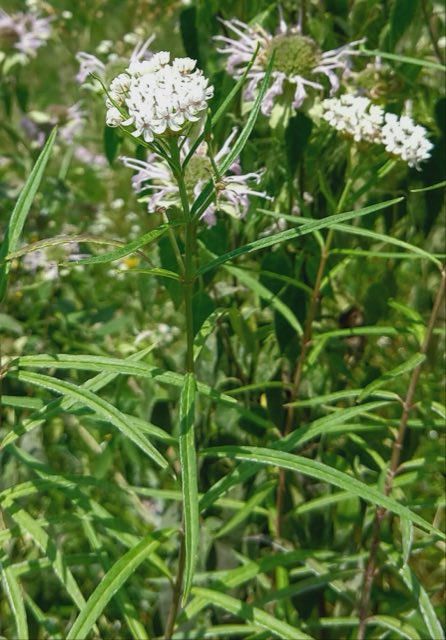
- Slender erect stems 20 to 70 cm tall, unbranched or with a few shoots from the middle and upper nodes.
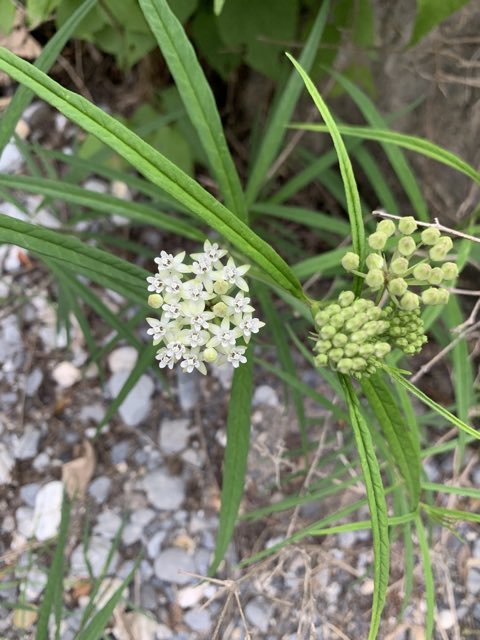
- Opposite, almost stalkless leaves, linear to narrowly lanceolate, 4 to 12 cm long and only 2 to 11 mm wide, tapering at both ends and hairless on both surfaces.
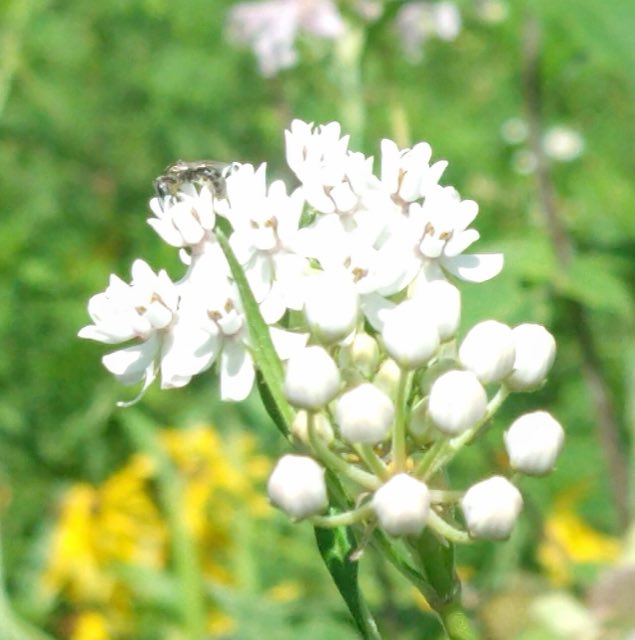
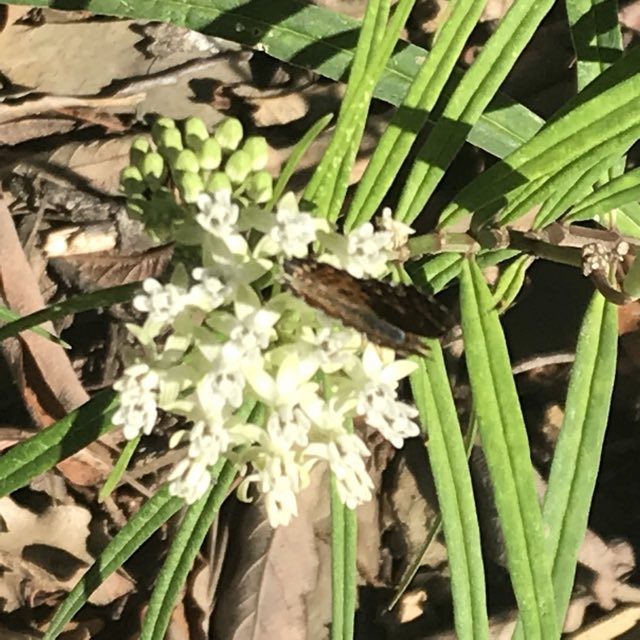
- White flowers, sometimes tinged pink or pale purple, in umbels 2 to 3 cm across borne at the sides of the upper stem rather than at the tip.
- Habitat is the giveaway: canyon bottoms, floodplain meadows and cienega edges between about 3,500 and 7,000 feet.
Unfamiliar words are in the glossary, and the identification key will narrow a plant down from what you can see.
Ecology and wildlife value
A documented monarch and queen host in southeastern Arizona, and one of the few milkweeds available to them in the Madrean canyons. Its riparian habitat concentrates butterflies, so a small stand carries more traffic than its size suggests.
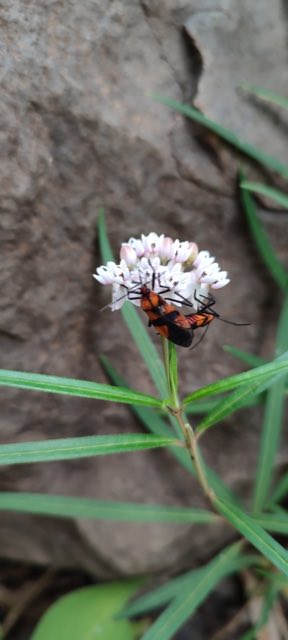
Monarchs are not the only thing that will find it. Expect large milkweed bugs on ripening pods, oleander aphids on the stems, red milkweed beetles at the flowers and, in late summer, milkweed tussock moths. Everything that lives on milkweed.
Growing arizona milkweed
Grown in butterfly gardens around Tucson and the Huachucas and occasionally offered by Southwest native nurseries. It wants more water than the desert milkweeds: give it a spot that stays damp below the surface, with sun for part of the day and shade for the rest.
Seed needs about 30 days of cold-moist stratification. Deep taproot, resents transplanting. See how to plant milkweed seed for the full method.
Cautions
Standard milkweed cautions. Milky sap, irritating to eyes. More on milkweed toxicity.
Where arizona milkweed grows
Recorded in 1 state: Arizona.
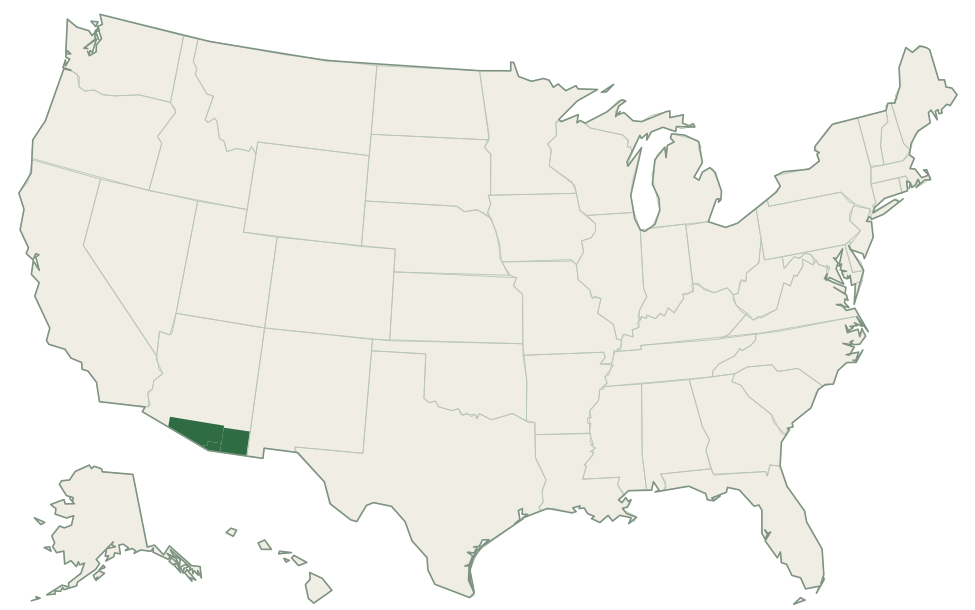
County records from USDA PLANTS, public domain. Cross-check against BONAP and your regional flora before making management decisions.
Frequently asked questions
Where does Arizona milkweed actually grow?
Only in southeastern Arizona within the United States, in the canyons and cienegas of the sky island ranges. It is far more widespread south of the border, running down through Sonora and Chihuahua into central Mexico, which is why a plant that is rare here is not rare overall.
Is Asclepias angustifolia the same as narrowleaf milkweed?
No, and the names invite the mistake. Narrowleaf milkweed is Asclepias fascicularis, a widespread western species with whorled leaves. Asclepias angustifolia has opposite leaves and in the United States is restricted to southeastern Arizona. An older name, Asclepias angustifolia Elliott, refers to something else entirely and is not this plant.
References and further reading
Names, ranges and conservation status here are drawn from the databases below. Where those disagree with a regional flora, trust the flora.
- Plants of the World Online 94096-1. Royal Botanic Gardens, Kew. Accepted name, authorship and global distribution.
- GBIF 3170306. Global Biodiversity Information Facility. Aggregated occurrence records.
- iNaturalist 47908. Community observations, photographs and phenology.
- Wikipedia. General-audience article on this species.
- BONAP county distribution map. Biota of North America Program. County-level range map.
- NatureServe Explorer. Conservation status ranks at global and state level.
- World Flora Online. Nomenclature and synonymy.
- Woodson, R. E. (1954). The North American species of Asclepias L.. Annals of the Missouri Botanical Garden 41(1): 1–211. The monograph the modern taxonomy of the genus still rests on. View
- Flora of North America Editorial Committee (eds.) (2026). Flora of North America North of Mexico. Oxford University Press, New York and Oxford. Accepted names, keys and descriptions for the North American flora. View
- Royal Botanic Gardens, Kew (2026). Plants of the World Online. Facilitated by the Royal Botanic Gardens, Kew. Nomenclature and global distribution, keyed to IPNI name identifiers. View
- Kartesz, J. T. (Biota of North America Program) (2026). North American Plant Atlas. BONAP, Chapel Hill, North Carolina. County-level distribution maps, the basis for the ranges generalized here. View
- USDA, NRCS (2026). The PLANTS Database. National Plant Data Team, Greensboro, North Carolina. State-level distribution, wetland status and nomenclature. View
- Agrawal, A. A. (2017). Monarchs and Milkweed: A Migrating Butterfly, a Poisonous Plant, and Their Remarkable Story of Coevolution. Princeton University Press. The standard general account of the milkweed and monarch relationship. View
Cite this page
This page is licensed CC BY 4.0. Quote it, adapt it and reuse it, including commercially, as long as you credit Milkweed USA and link back.
Milkweed USA. (2026). Arizona Milkweed (Asclepias angustifolia). Retrieved DATE, from https://milkweedusa.com/species/arizona-milkweed/
"Arizona Milkweed (Asclepias angustifolia)." Milkweed USA, 2026, https://milkweedusa.com/species/arizona-milkweed/. Accessed DATE.
Milkweed USA. "Arizona Milkweed (Asclepias angustifolia)." Last modified 2026-08-01. Accessed DATE. https://milkweedusa.com/species/arizona-milkweed/.
@misc{milkweedusa_speciesarizonamilkweed,
  title  = {Arizona Milkweed (Asclepias angustifolia)},
  author = {{Milkweed USA}},
  year   = {2026},
  url    = {https://milkweedusa.com/species/arizona-milkweed/},
  note   = {Accessed DATE}
}