Milkweed around the world
Mexico has more milkweed species than the United States and grows the forest the monarchs winter in. Canada had it on a noxious weed list until 2014. And in Europe, the plant Americans are urged to plant is one landowners are legally required to remove.
Almost everything on this site is about the United States, because that is where most milkweed species are and where most people reading it are planting. This page is the other half of the picture.
Where the genus actually lives
Asclepias holds roughly two hundred species, and the overwhelming majority of them are American. About 130 occur in North America north of Mexico and in Mexico itself, with a smaller set scattered through Central and South America. Seventy-two are profiled here.
Older floras put a great many African plants in Asclepias as well, which is why the genus is sometimes still described as African-American in distribution. Most of those have since been moved out into Gomphocarpus, Pachycarpus, Xysmalobium, Aspidoglossum and Schizoglossum. What is left in Asclepias is essentially a New World genus with a handful of contested African species.
North America is one system, not three
The United States is where this site looks, and it is the wrong unit for the thing it is about. The eastern monarch migration runs across three countries and fails if any one of them stops working. Mexico grows the forest the butterflies spend the winter in, the United States and southern Canada grow the milkweed they breed on, and the whole cycle takes four generations and about 3,000 miles to close.
Mexico
Mexico has more milkweed than the United States does. Around seventy Asclepias species occur there, many of them endemic to the Sierra Madre and the Trans-Mexican Volcanic Belt, and the genus reaches its center of diversity somewhere between the two countries rather than inside either. Several species that Americans think of as theirs, pineneedle milkweed and antelope horns among them, are really northern outliers of a Mexican flora that reaches into Arizona, New Mexico and Texas. Tropical milkweed, the plant that causes so much argument in Florida and California, is a native Mexican wildflower doing nothing wrong at home.
The overwintering forests are the other half. Almost the entire eastern monarch population spends the winter in stands of oyamel fir, Abies religiosa, at between about 2,900 and 3,300 meters in Michoacán and the State of Mexico. The altitude gives them the narrow band of conditions they need: cold enough to hold their metabolism nearly still, not so cold that they freeze, and humid enough that they do not dry out. The Monarch Butterfly Biosphere Reserve covers roughly 56,000 hectares and has been a UNESCO World Heritage Site since 2008.
The butterflies arrive at the end of October and the beginning of November, which is to say at Día de Muertos. In Purépecha and Mazahua tradition the returning monarchs are associated with the souls of the dead coming home, and the coincidence of timing is old enough to be woven into the calendar rather than noticed as a curiosity.
The population is measured in hectares of occupied forest rather than in butterflies, because nobody can count them. The peak recorded was 18.19 hectares in the winter of 1996 to 1997. Recent winters have been between about one and two and a half hectares. That figure, published each year by WWF Mexico and Mexico's national protected areas commission, is the number that every statement about monarch decline ultimately rests on.
Canada
Canada has about a dozen Asclepias species. Common milkweed dominates in southern Ontario and Quebec, showy milkweed takes over through the prairie provinces and into British Columbia, and swamp, butterfly and whorled milkweed turn up across the settled south. Almost none of it reaches far north; the country's milkweed, and its monarchs, live in a thin band along the border.
Two things there are worth knowing about. The first is a policy reversal: common milkweed was a noxious weed in Ontario law until 2014, when it was removed from the schedule of the Weed Control Act specifically because it is the monarch's host plant. Farmers had a legal obligation to destroy the plant the butterfly cannot live without. Ontario is not alone in having had such a law, and the change is a useful reminder that this is a recent argument rather than a settled one.
The second is fall migration. Southern Ontario ends in a series of points and peninsulas that funnel southbound monarchs down to the Lake Erie shore, where they gather and wait for the wind before crossing open water. Point Pelee and Long Point are the best known, and in a good September the roosting trees there are worth a long drive.
Canada also uses the plant. A growers' cooperative in Quebec harvests milkweed floss commercially for insulation and as an oil-spill sorbent, which makes common milkweed one of the few plants that is a protected wildlife host and a field crop in the same province.
The monarch's legal status in Canada has moved. COSEWIC, the national assessment body, reassessed it from Special Concern to Endangered in 2016, on the strength of the Mexican overwintering figures rather than anything happening to Canadian breeding habitat.
Further south
Asclepias curassavica is genuinely native from Mexico through Central America, the Caribbean and into South America, where a further handful of Asclepias species occur. Monarchs are resident through much of that range and do not migrate at all: there is no reason to, when the season never ends. Those populations were the source of the ones that later spread across the Pacific.
The wider family
Milkweeds sit in the subfamily Asclepiadoideae of the dogbane family, Apocynaceae, which runs to roughly 3,000 species worldwide. It is a much stranger group than the American milkweeds alone suggest:
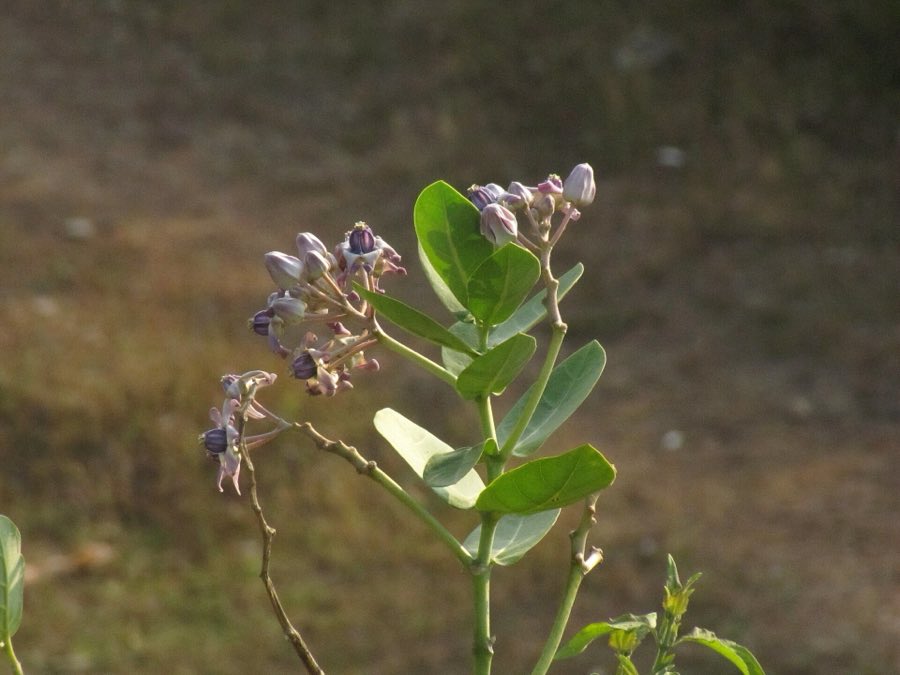
- Calotropis, the giant milkweeds, from West Africa through Arabia to South and Southeast Asia. Calotropis gigantea is the crown flower, grown in Hawaii and closely associated with Queen Liliʻuokalani, and C. procera is the apple of Sodom of the Middle East. Both are shrubs or small trees with thick, waxy purple-and-white flowers.
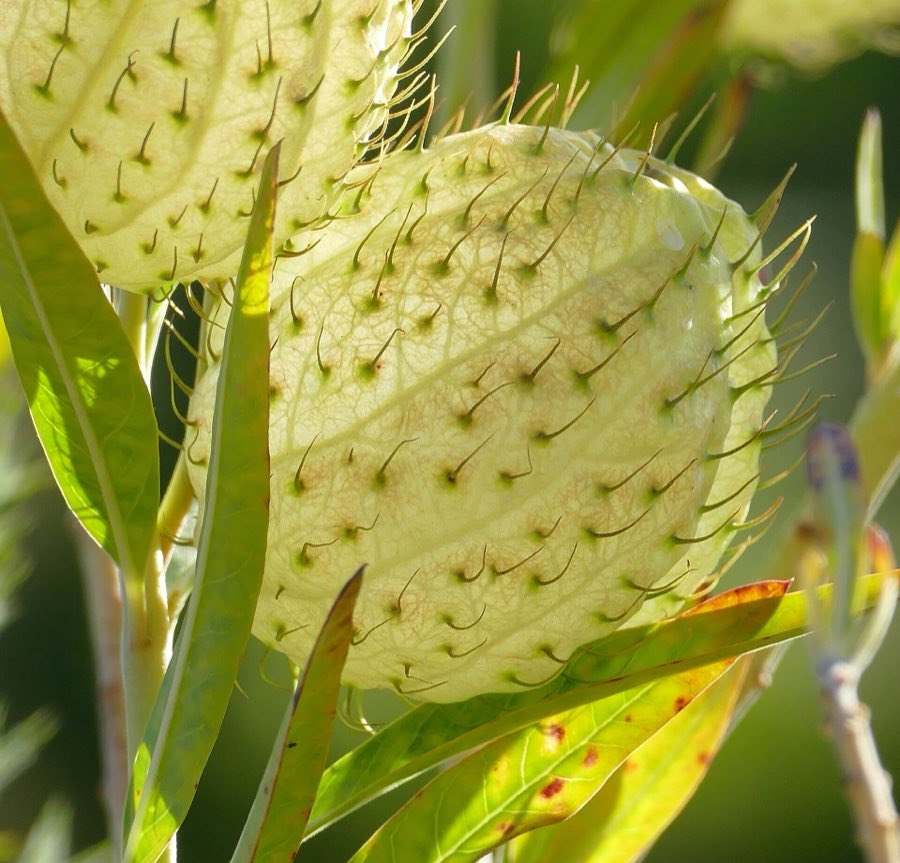
- Gomphocarpus, the balloon plants and swan plants of southern Africa, instantly recognizable from their inflated, bristly pods. Balloon plant is grown worldwide as a curiosity and a cut flower.
- Stapeliads, the carrion flowers of southern Africa: leafless, succulent, and pollinated by flies drawn to a smell of rotting meat.
- Hoya and Dischidia, the wax plants of tropical Asia and Australasia, which most people know as houseplants without ever connecting them to milkweed.
- Ceropegia, the lantern flowers, whose blooms temporarily trap small flies to load them with pollen.
- The milkweed vines, Funastrum, Cynanchum and Matelea, several of which reach the United States and feed queen and soldier butterflies.
What ties them together is the flower. Almost all of them parcel their pollen into paired sacs that clip onto a visitor rather than dusting it, a mechanism shared elsewhere only with the orchids.
Monarchs outside North America
The monarch is not confined to the Americas, and has not been for nearly two centuries. During the 1800s it spread west across the Pacific, reaching Hawaii around the 1840s, Australia by about 1871 and New Zealand shortly after. Separately it established in the Canary Islands, Madeira and the Azores, and from there on the mainland in southern Spain and Portugal. There are populations in Bermuda and through the Caribbean.
None of these are the migratory monarch of the North American imagination. They are resident, breeding year-round or nearly so, and they depend almost entirely on introduced plants: Asclepias curassavica, Gomphocarpus and Calotropis. The New Zealand swan plant trade exists largely to feed them.
This matters for one of the most-argued questions in monarch gardening. Tropical milkweed causes problems in the United States precisely because it does not die back, which lets a migratory population stop migrating and lets the OE parasite build up. Where the population is resident anyway, as in Hawaii, that particular argument does not apply in the same form.
Milkweed butterflies that are not monarchs
The tribe Danaini is tropical and worldwide, and the monarch is one of its more recent radiations rather than its center.
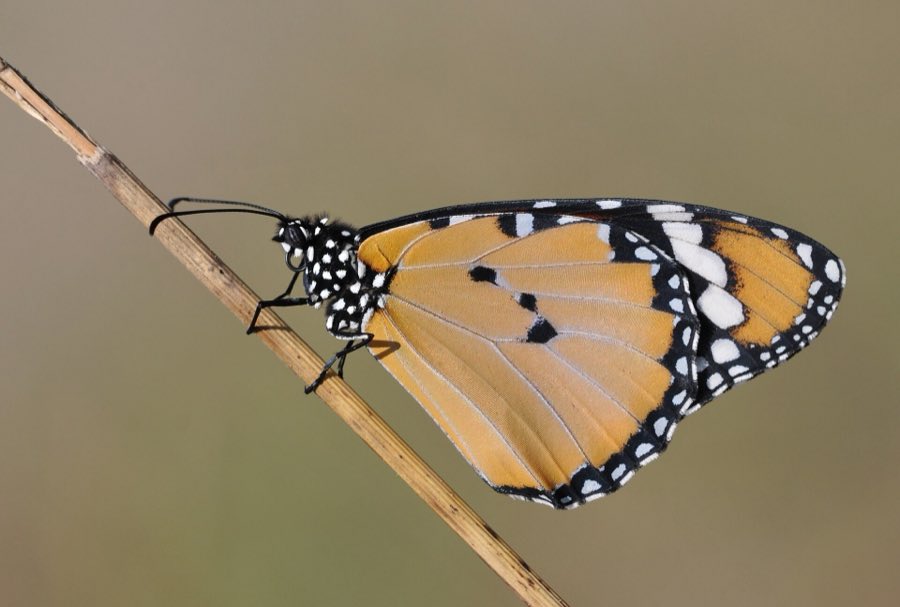
- Danaus chrysippus, the plain tiger or African monarch, ranges across Africa, southern Europe, the Middle East, Asia and Australia. It feeds on Calotropis, Gomphocarpus, Pergularia and introduced Asclepias curassavica, and it is the model in one of the textbook mimicry systems, copied by the female of the danaid eggfly Hypolimnas misippus.
- Danaus genutia, the common tiger, does the same job across South and Southeast Asia.
- The crow butterflies, Euploea, are dark, glossy and abundant from India to Australia, and several of them form overwintering aggregations that look startlingly like a monarch roost.
Where milkweed is the problem
This is the part that surprises American readers. Common milkweed is an invasive weed in Europe. Asclepias syriaca was introduced as a fiber and ornamental crop in the eighteenth century, escaped, and is now firmly established across the Pannonian basin, particularly in Hungary, Serbia and Romania, where it takes over sandy grassland of high conservation value.
In 2017 it was added to the European Union's list of invasive alien species of Union concern, which obliges member states to prevent its introduction, detect it early and manage established populations. The plant that American conservationists ask people to plant is one that Hungarian landowners are legally required to control.
The same reversal turns up elsewhere. Calotropis procera is a declared weed across northern Australia and much of Brazil, where it colonizes overgrazed rangeland. Asclepias curassavica is naturalized and weedy through much of the tropics. Gomphocarpus species are naturalized in Australia, New Zealand, Hawaii and California.
The lesson is the ordinary one about native plants: a species is not good or bad, it is in place or out of place. Plant what belongs where you live.
Milkweed as a crop
People have used these plants for a long time, and mostly for fiber.
- Calotropis bark yields ak or madar fiber in South Asia, historically used for rope, nets and sacred thread, and the latex appears in traditional medicine and, in places, on arrow tips.
- Milkweed floss is hollow, waxed and remarkably buoyant. When Japan cut off the supply of Asian kapok in 1942, the United States ran a national program collecting Asclepias syriaca pods, much of it by schoolchildren, and stuffed them into military life jackets. It is sold today as a hypoallergenic down substitute and as an oil-spill sorbent, because it absorbs oil and repels water.
- Gomphocarpus physocarpus is grown commercially as a cut flower for its pods.
- Asclepias tuberosa was traded as pleurisy root, a respiratory remedy, and remains one of the more commonly encountered milkweed names in old herbals.
So is milkweed native to other countries?
The genus Asclepias is essentially American, and where it grows elsewhere it has been carried there. The wider milkweed family is genuinely worldwide, and Africa is its center of diversity in terms of sheer strangeness of form. And the monarch, the butterfly the whole American conversation turns on, now breeds on four continents on plants that mostly are not native to those either.
Frequently asked questions
Does milkweed grow in Mexico?
Extensively. Around seventy Asclepias species occur in Mexico, more than in the United States, and the genus reaches its center of diversity between the two countries. Mexico also holds the oyamel fir forests where almost the entire eastern monarch population spends the winter.
Where do monarch butterflies overwinter in Mexico?
In stands of oyamel fir at between about 2,900 and 3,300 meters in Michoacan and the State of Mexico, mostly inside the Monarch Butterfly Biosphere Reserve, a UNESCO World Heritage Site of roughly 56,000 hectares. The population is measured as hectares of occupied forest rather than as a count of butterflies.
Does milkweed grow in Canada?
Yes, about a dozen Asclepias species, concentrated in a band along the southern border. Common milkweed dominates in Ontario and Quebec and showy milkweed through the prairie provinces. Common milkweed was legally a noxious weed in Ontario until 2014, when it was removed from the Weed Control Act because it is the monarch’s host plant.
Is milkweed native to Europe?
No. No Asclepias species is native to Europe. Common milkweed was introduced from North America in the eighteenth century as a fiber and ornamental plant, escaped cultivation, and has been on the European Union list of invasive alien species of Union concern since 2017.
Does milkweed grow in Africa?
Milkweed relatives do, in abundance. Africa is the center of diversity for the wider milkweed subfamily, including Gomphocarpus, Pachycarpus, Xysmalobium and the succulent stapeliads. True Asclepias, as the genus is now defined, is essentially American.
Are there monarch butterflies outside North America?
Yes. Monarchs established in Hawaii, Australia, New Zealand and the Pacific islands during the 1800s, and in the Canary Islands, Madeira, the Azores, southern Spain and Portugal. All of these populations are resident rather than migratory and depend largely on introduced milkweeds.
What is the African monarch butterfly?
The plain tiger, Danaus chrysippus, a close relative of the monarch found across Africa, southern Europe, Asia and Australia. It feeds on Calotropis and other milkweed relatives and is the model in a well-known mimicry system with the danaid eggfly.
What is giant milkweed?
Calotropis gigantea and Calotropis procera, shrubs or small trees of Africa and Asia with thick waxy flowers and large leaves. C. gigantea is the crown flower grown in Hawaii. Both are milkweed relatives, both are monarch host plants where the two overlap, and both are invasive weeds in parts of Australia and Brazil.
Cite this page
This page is licensed CC BY 4.0. Quote it, adapt it and reuse it, including commercially, as long as you credit Milkweed USA and link back.
Milkweed USA. (2026). Milkweed around the world. Retrieved DATE, from https://milkweedusa.com/guides/milkweed-around-the-world/
"Milkweed around the world." Milkweed USA, 2026, https://milkweedusa.com/guides/milkweed-around-the-world/. Accessed DATE.
Milkweed USA. "Milkweed around the world." Last modified 2026-08-01. Accessed DATE. https://milkweedusa.com/guides/milkweed-around-the-world/.
@misc{milkweedusa_guidesmilkweedaroundtheworld,
  title  = {Milkweed around the world},
  author = {{Milkweed USA}},
  year   = {2026},
  url    = {https://milkweedusa.com/guides/milkweed-around-the-world/},
  note   = {Accessed DATE}
}