Red milkweed beetle
Tetraopes tetrophthalmus
A red longhorn beetle whose antennae grow straight through its eyes, splitting each one in two.
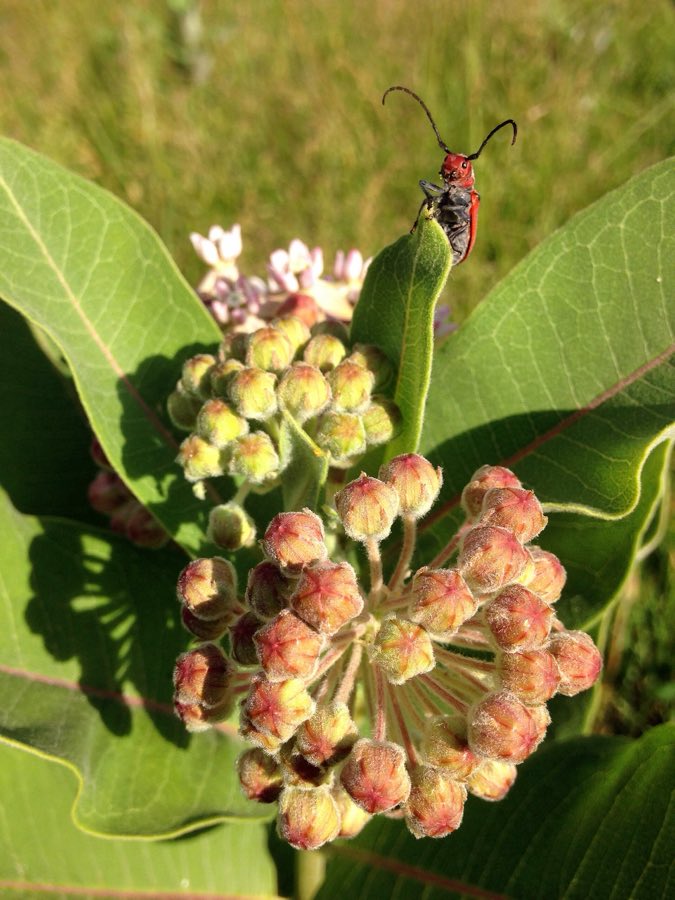
What it does on milkweed
Adults feed on milkweed leaves, buds and flowers through midsummer. Females lay eggs in stems near the base, and the larvae drop to the soil and tunnel into the roots, where they overwinter. Adults stridulate audibly when handled. Both Tetraopes and Latin tetrophthalmus mean four-eyed, a double reference to the fact that the base of each antenna passes straight through the eye and divides it.
How to recognize it
Around 8 to 15 mm, bright brick red with four black spots on the wing covers and long black antennae. Look closely at the head: each antenna emerges from the middle of an eye.
Where and when
Eastern and central North America, closely following common milkweed. Most often seen June to August.
Should you do anything about it?
No action needed. Root damage is real but rarely enough to matter to an established stand.
Red milkweed beetle: common questions
Why is it called the four-eyed beetle?
The base of each antenna runs directly through the compound eye, dividing it into an upper and a lower half. Both halves of the scientific name refer to it.
Cite this page
This page is licensed CC BY 4.0. Quote it, adapt it and reuse it, including commercially, as long as you credit Milkweed USA and link back.
Milkweed USA. (2026). Red milkweed beetle (Tetraopes tetrophthalmus). Retrieved DATE, from https://milkweedusa.com/wildlife/red-milkweed-beetle/
"Red milkweed beetle (Tetraopes tetrophthalmus)." Milkweed USA, 2026, https://milkweedusa.com/wildlife/red-milkweed-beetle/. Accessed DATE.
Milkweed USA. "Red milkweed beetle (Tetraopes tetrophthalmus)." Last modified 2026-08-01. Accessed DATE. https://milkweedusa.com/wildlife/red-milkweed-beetle/.
@misc{milkweedusa_wildliferedmilkweedbeetle,
  title  = {Red milkweed beetle (Tetraopes tetrophthalmus)},
  author = {{Milkweed USA}},
  year   = {2026},
  url    = {https://milkweedusa.com/wildlife/red-milkweed-beetle/},
  note   = {Accessed DATE}
}